September 6, 2016

Vertical of the month: Cantina Terlano Pinot Bianco Vorberg Riserva 2012-1994

Pinot Blanc, that white mutation of the world-famous Pinot Noir, has never had much of attention nor following. And I am not blaming anybody for it – whereas Pinot Noir can mace delicate, immensely attractive and infinitely complex red wines capable of withstand decades of aging, Pinot Blanc normally seems capable of producing only simple, soft and fruity white wines redolent of peaches and ripe apples and never aging further than a handful of years.

However, this is not always the case. For example, the variety seems to thrive in the German region of Rheinhessen, where quality-oriented producers can make remarkable white wines of astounding depth, structure and opulence out of Pinot Blanc – or Weissburgunder (or Weisser Burgunder) as it is known there. But it might just be that there is no other winery making as astounding and ageworthy Pinot Blancs as Cantina Terlano, the small and well-respected co-operative from South Tyrol, Northern Italy.

Pinot Blanc originated from Burgundy as a white mutation of the Pinot Noir – apparently not only once, but several times during the history – but it was often confused with the other local variety, Chardonnay. From Burgundy, the variety first travelled to Alsace and Switzerland, and later on all over the world. Though cultivated in small quantities in a big number of wine-producing countries, Pinot Blanc has found its home especially in Alsace, Luxembourg, Germany, Italy and Slovakia. In Alsace and Slovakia (where the variety is known as Rulandské Bílé) the variety is normally seen as a simple workhorse variety – mainly for making simple and inexpensive everyday wines. In Germany and Luxembourg many producers have realized the variety's potential, producing more impressive, structured and complex wines than the neighboring Alsace.

But what makes the aforementioned Cantina Terlano so unique is that so often Italian Pinot Bianco (the local synonym for Pinot Blanc) offers nothing of interest: the vines are usually planted in locations poorly suited to the variety, resulting wines that are either thin and neutral (if picked too early) or just simple, fruity and lacking structure (if picked ripe). This is why I was a little hesitant when I was invited to a two-day vertical of Pinot Bianco Vorberg. However, I didn't need much time convincing myself on going, remembering the reputation of winery in question and the few wines I had tasted from them.

Cantina Terlano, or Kellerei Terlan, is a co-operative founded by 24 South-Tyrol winegrowers in 1893. Unlike many other producers in Südtirol / Alto Adige (the local names for the bilingual region), that are often large and quantity-oriented, Cantina Terlano is a relatively small producer with 160 hectares (400 acres) and their main focus is on long-lived quality wines, result of severe reduction of yields, rigorous selection of the healthy grapes and keen winemaking utilizing old, large wooden barrels and extended sur lie aging. The co-op currently has 120 members, which means that the average holding for one grower is a little less than 1,5 ha.

Cantina Terlano Pinot Bianco Vorberg Riserva
DOC Südtirol / Alto Adige
  • Cantina Terlano / Kelleri Terlan
  • Country: Italy
  • Region: Trentino - Südtirol / Alto Adige, Alto Adige
  • Grape(s): Pinot Bianco (100%)


Pinot Bianco Vorberg Riserva (or just plain Pinot Bianco Vorberg until 2001) is one Cantina Terlano's flagship wines and considered to be one of the best (if not the best) Pinot Blanc wines in the world. Vorberg is a region of steep, south-to-southwest-facing vineyards at the altitudes between 450 and 950 meters above the sea level. In these vineyards grow the most concentrated and structured Pinot Bianco grapes of Cantina Terlano and from these grapes they make their spectacular varietal riserva wine. The wines are slowly fermented in old 3,000 liter oak casks, and after the fermentation the wines are left to age on the yeast lees (sur lie aging) in the same barrels for 12 months. The annual production is around 55,000 bottles.

***

Pinot Bianco Vorberg Riserva 2012
  • Tasted on: September 30th, 2015
Pale lime-green color. Cool, alpine and somewhat restrained nose with cool aromas of yellow apple, wet stones and hints of citrus fruit. In the mouth the wine has a lot more weight with goods sense of richness and concentration. Intense flavors of juicy peach, ripe apple, some prickly mineral bitterness and a hint of pineapple. Despite its size the wine feels firm and structured, thanks both to bright minerality and high acidity. Slightly ripe-sweet, medium-length finish with succulent yellow stone fruits, stony minerality and a hint of herbal bitterness.

89/100
Summary: An intense, structured Pinot Blanc with a lot more depth and concentration than its peers from Alsace. However, lacks the complexity and impressiveness the best German Weissburgunders show.

***

Pinot Bianco Vorberg Riserva 2011
  • Tasted on: September 30th, 2015
Pale lime-green color. Ripe, fruity nose showing peach-driven aromas of yellow stone fruits and some honeyed sense of maturity. Rich, lively and full-bodied palate but with surprisingly restrained flavor profile. The taste seems playful, but with fruit in the background and leaving very little on the fore; youthful flavors of apple and vague citrus fruits. With the lack of fruit, the high acidity feels a bit pronounced. Long, vibrant and more nuanced finish with ripe yellow fruit flavors, high acidity, some stony minerality and a hint of salinity.

87/100
Summary: A very restrained example of Vorberg Riserva; this vintage seemed almost austere compared to the rest of the wines. Might be that the wine is just in a dumb phase. A good Pinot Blanc, but nothing really memorable.

***

Pinot Bianco Vorberg Riserva 2009
  • Tasted on September 30th, 2015
A hot vintage. Pale lime-green color with faint lemony yellow highlights. A little restrained, cool nose with aromas of sweet lemony citrus fruits and orange blossom, some vague yellow fruit, a hint of almonds and a whiff of apricot marmalade. Rich, full-bodied and concentrated palate with moderate acidity that seems to grow from underneath the succulent fruit flavors. Intense, opulent flavors of pineapple, ripe peach, some red apple and a hint of bitterness. Despite its opulence, there is definite sense of structure. The finish is as full-bodied and succulent as the midpalate, but along with flavors of sweet apple, peach and apricot, there are more pronounced notes of bitter minerality and herbs.

90/100
Summary: Although this is obviously a very big and ripe, even massive, Pinot Blanc, the 2009 vintage shows good, balanced structure. The wine is starting to show first signs of maturity, but it will definitely hold for years – if not for decades – in a cellar. Shows a lot of promise, but does not offer much else than big body and ripeness at the moment.

***

Pinot Bianco Vorberg Riserva 2008
  • Tasted on September 30th, 2015
Moderately deep yellow-green color showing a hint of age. Very rich, complex and modestly developed nose with layered aromas of sweet, exotic fruits, yellow stone fruits, ripe yellow apple, some dried apricot, honeyed dessert wine nuances and a hint of vanillin. Quite full-bodied, intense and acid-driven – even a bit robust – in the mouth with powerful, concentrated flavors of ripe citrus fruits, wet rock minerality, almost ripe peaches and some green herbal nuances. The wine has impressive, almost tightly-wound structure. Though rich and opulent, the finish is also very powerful and structured with pronounced, long-lingering flavors of apricot, stony minerality, complex spice and some apple purée.

94/100
Summary: Out of the more recent vintages, the 2008 is easily the most impressive effort with a stunning combination of focused power and ripe, opulent fruit. The wine is starting to show some mature complexity, but the emphasis is on ripe, youthful fruit and the wine still has cellaring potential worth a decade or two left in it. Striking.

***

Pinot Bianco Vorberg Riserva 2007
  • Tasted on September 30th, 2015
Medium-deep yellow-green color; a bit lighter than the 2008. The nose is surprisingly dry and restrained in character with aromas of steel, sweet apple, some nuttiness and a hint of bready oxidation – is the wine already past its peak? In the mouth the wine is quite light-bodied and more dry and ripe-sweet, with intense, high-acid structure. Powerful flavors of ripe red apple, peach, some lemon marmalade and hints of apple jam that show some sense of concentration. Long, vibrant and quite dry finish with more emphasis on freshness and acidity than on ripeness and opulence; flavors of citrus fruits, ripe apple, spicy minerality and some mouth-drying sense of astringency in the aftertaste.

91/100
Summary: A lot lighter and more restrained style of Vorberg here with less ripeness and more emphasis on acidity and fresh fruit flavors. Still in pristine condition, although the nose suggested otherwise; however, I'd wager this vintage will not hold as long as the bigger. Wonderful now and still has some room for further development in the cellar.

***

Pinot Bianco Vorberg Riserva 2005
Tasted on September 30th, 2015
Intense golden yellow color. Ripe and complex, but slightly muted nose with aromas of dried yellow fruits, some dried aromatic herbs, a little smoky nuttiness and a hint of bready oxidation. Full-bodied and moderately concentrated palate with somewhat developed flavors of ripe, succulent pear, dried yellow fruits, some spicy bitterness, sweet tangerine notes and a hint of caramel. Moderately long, lively and complex finish showing both some sweetness and freshness with bright acidity and layered flavors of lemony citrus fruits, lemon marmalade, some wizened apricot and a hint of nuttiness.

93/100
Summary: Really lovely and attractive example of a 10-years old Vorberg that is balancing nicely with some remnants of primary fruit, more concentrated fruit flavors and more developed, non-fruit tertiary notes. This wine is starting to show why one should keep Vorbergs in a cellar for years before opening them; it's just beginning to drink nicely. Will probably develop nicely over some years and will definitely keep at least for another decade.

***

Pinot Bianco Vorberg Riserva 2004
  • Tasted on September 30th, 2015
Deep canary yellow color. Complex, layered bouquet redolent of developed nuances; aromas of old dry wood, powerful mirabelle plum fruit, developed spicy notes, some smoke, nuances of ripe and sweet yellow stone fruits, a little wizened apricot and a whiff of dried flowers. The wine is full in body with quite modest acidity and ample, sweet and developed fruit flavors. Notes of ripe citrus fruits, apricot, yellow plum marmalade, complex floral nuances, some stony minerality, aromatic herbal notes and a touch of lanolin waxiness. With its sense of maturity, silky texture and rather low acidity, the wine feels very smooth and restful in the mouth. The finish is very powerful, opulent and extremely lengthy with layered, intermingling nuances of yellow apple, peach, some stony minerality, a little honeyed florals and a touch of almonds.

92/100
Summary: This Vorberg would easily be one of the most impressive vintages of the 00's, were it not for its rather low acidity, which makes the wine seem rather heavy and a bit flabby. As the wine is showing a remarkable cavalcade of more mature characteristics I can guess that the wine seems to both age and, eventually, deteriorate faster than the more acid-driven vintages. Though this 2004 has still some life left ahead, I suggest it to be drunk sooner rather than later.

***

Pinot Bianco Vorberg Riserva 2003
  • Tasted on: September 30th, 2015
Modestly pale lemon yellow color with fain green highlights. Rich, ripe and succulent nose with intense aromas of apricot, dried peach, some sweet fruit candy aromas and a hint of floral complexity. Full-bodied palate with rather modest acidity and velvety texture. Quite mineral-driven palate with ripe and moderately sweet flavors of red apple, peach, bitter stony minerality, some yellow plum notes and mature, slightly smoky and nutty nuances. The acidity does not really cut through the body that seems to have concentrated with age, but it gives the wine some sense of structure. Vibrant, succulent and very persistent finish with complex, long-lingering nuances of juicy peach, tangerine, ripe red apple, some wet stone minerality and a hint of almond paste.

93/100
Summary: Stylistically very close to the 2004 vintage with rather low acidity and plump body, but the 2003 seems to show a bit more depth, complexity and structure than the 2004. Furthermore, it seems also slightly younger and more balanced, giving it better cellaring potential. No need to hurry with this one.

***

Pinot Bianco Vorberg Riserva 2002
  • Tasted on: June 10th, 2015
Deep golden yellow. Ripe, concentrated and developed nose with a plethora of mature nuances: dried pineapple, wizened peach, roasted nuts, some smoke and a hint of caramelized ginger. The nose leads to expect something concentrated and voluminous, but the wine is actually surprisingly light on its feet with medium body at most and high, structured acidity. Surprisingly dry and even crisp flavors for a Vorberg of this age with flavors of mature nuttiness, smoke and some complex spices, quite pronounced, stony minerality, some sweet yellow apple, a little honeydew melon and a hint of florals. Long, mineral finish with dry, refreshing flavors of ripe citrus fruits, tart Granny Smith apple, wet stones, some waxy notes and a hint of honey.

93/100
Summary: A more delicate and lighter expression, like the vintage 2007, but with more depth, complexity and precision. I really enjoyed this one with it refreshing character, even crisp at times, marrying more developed notes with lighter, drier and more acid-driven fruit characteristics. Starting to drink really nicely now, but has years of life still left with potential to kick up its score a notch or two.

***

Pinot Bianco Vorberg 2001
  • Tasted on: June 10th, 2015
Deep golden yellow. A bit closed and reticent nose with developed, and even slightly dusty aromas of spicy wildhoney, dried pear slices, walnuts, some ripe green fruits and a hint of hay. Moderately aged and rather full-bodied palate with good, refreshing acidity and complex flavors of honey and spicy wildhoney, stony minerality, tart green apple, roasted nuts, almond paste, some aromatic herbs, hay notes and a hint of oxidative biscuit. Very long, rich and persistent finish with complex, mature flavors spice and wildhoney, yellow plums, some roasted almonds and a hint of hay.

92/100
Summary: A really attractive, fully mature Vorberg that has obviously reached its plateau of maturity and most likely won't keep much longer. Though there is some sense of concentrationg brought by age, the wine is remarkably fresh and structured with a lot of vibrancy and precision. However, the wine won't most likely gain any additional complexity with further cellaring, so I'd suggest drinking up.

***

Pinot Bianco Vorberg 2000
  • Tasted on: June 10th, 2015
Medium golden yellow, a bit more pale than the two previous vintages, with faint green highlights. Surprisingly youthful, fruit-forward and refreshing nose with vibrant aromas of yellow stone fruits, honeydew melon, star fruit, some sweet pear marmalade and a hint of developed smoky complexity. Waxy, medium-bodied palate that is all about balance; the flavors are not young anymore, yet the wine doesn't seem to offer any mature characteristics either. The wine is bursting with ripe flavors of mirabelle plums, star fruit, pronounced spiciness, stony minerality, ripe apple, some honey and hints of sweet white peach. Though the acidity is not pronounced, it is still rather high, giving the wine good sense of structure. Finally the wine turns to its very long, spicy and acid-driven finish with ripe fruit flavors of yellow plums and apples, some orange and a hint of star fruit. The only giveaway of the wine's age is the light nutty complexity that appears towards the end of the aftertaste.

94/100
Summary: A superb vintage of Vorberg, that is still barely halfway up – the wine is still so youthful and energetic it's hard to understand it has 15 years under its belt! Probably hitting its stride 5–10 years from now, so it would be a shame opening this now. Lots of room left for further improvement.

***

Pinot Bianco Vorberg 1999
  • Tasted on: June 10th, 2015
Rather pale yellow-green color; by its looks, this is something completely different from the previous, golden yellow wines. Quite rich and obviously mature nose with toasty aromas of roasted nuts, smoke, peach, dried pineapple, some orange marmalade, a hint of complex, aged spiciness and a faint, grassy, vegetal note. Surprisingly light, zippy and bright palate with light-to-medium body and pronounced acidity. Almost atypical flavors of green apples, grassy greenness, lemony citrus, walnuts, wet stone minerality, some sweeter notes of nougat and a hint of star fruit. Bright and refreshing finish with almost crisp flavors of green apple, ripe citrus fruits, something green, stony minerality, a little creaminess and a hint of herbal bitterness.

92/100
Summary: One of those lighter vintages of Vorberg with very different aroma- and taste profile from the usual Vorberg style – light in body, high in acidity and faint nuances of grass and other greenish vegetal notes. However, the wine is also really attractive and sophisticated with more youthful palate than what the rather mature nose leads to expect. Still cellarworthy for a good number of years, although drinking nicely already.

***

Pinot Bianco Vorberg 1998
  • Tasted on: June 10th, 2015
Concentrated honey yellow color. Very complex, mature nose with layered aromas of yellow plums, pear marmalade, intriguing waxy notes, gummy bears, orange-flavored hard candy, some dried mushroom, a little cream, hints of basil and a whiff of dried straws. Developed dry, medium-bodied palate with dense, concentrated flavors of nuts, yellow apple, hay, some wet stone minerality, notes of dried apricots, a little apple peel bitterness and oxidized nuances of browned apple core and toasty biscuit. Good, refreshing and structured acidity. Quite long, juicy and developed finish with layered nuances of smoke, spicy matured notes, nuts, some bruised apple and hints of tart lemon.

93/100
Summary: This one is definitely peaking now. Very mature characteristics with concentrated palate that seems to have also shed its baby fat – there is no excess ripeness or fruit, but only the linear core with good, structured acidity, balanced minerality and complex, layered tertiary flavors. Not really powerful, but still shows some lovely intensity. Not in need of further cellaring.

***

Pinot Bianco Vorberg 1997
  • Tasted on: June 10th, 2015
Medium-deep lemon yellow color with pale green hues. Very restrained and delicate nose showing some developed, autumnal notes of earth, porcini mushrooms and sous bois, with sweeter aromas of pear marmalade and honey beneath. Full-bodied and quite bitter palate with modest-to-low acidity. Concentrated flavors of honey, ripe yellow apple, dried peach and some nutty toasted aromas with very pronounced quinine mineral bitterness. Due to the low acidity the wine comes across a bit flatter than the other vintages. Succulent, ripe and quite long finish with flavors of peach, herbal bitterness, alpine minerality, some citrus fruits and a hint of nuttiness.

91/100
Summary: Another fully mature Vorberg; though the wine still has quite much life left, it has not withstood the age as good as the other vintages. Either the vintage has been a very low-acid one, or the sense of acidity has diminished over time; whatever the case, the wine seems a bit dull and lacking in brightness. Peaking now, better to drink soon.

***

Pinot Bianco Vorberg 1996
  • Tasted on: June 10th, 2015
Luminous, greenish pale yellow color. Paradoxically both very mature and surprisingly youthful nose with aromas of smoke, wizened stone fruits, some earthy mushroom notes, a little nuttiness and a hint of leather, with bright aromas of ripe peach, fresh red apple, some pineapple and hints of minty herbs giving an interesting counterpoint. In the mouth the wine is medium-bodied, incredibly youthful, full of vigor and power and almost crisp with its remarkably high acidity. Intense flavors of yellow and green apples, steely minerality, green herbs, sweet citrus fruits, some spiciness and hints of nutty and toasty maturity. Very youthful and vibrant finish with crisp flavors of green apples, dried aromatic herbs, ripe citrus fruits, steely minerality and something grassy, with only faint hints of developed dried fruit character.

95/100
Summary: Boy oh boy! Even at the age of 20, this wine is still a baby! Incredible structure, power and intensity with fruit that hasn't aged at all: this seems to be a white wine that will hold forever. This is like a young Vorberg, only with that depth and sense of concentration a wine gains with age, and without that ripe-fruity baby fat. Really impressive stuff, no point opening this in a while. Probably will develop much more with time.

***

Pinot Bianco Vorberg 1995
  • Tasted on: June 10th, 2015
Luminous, medium-deep lemon yellow color with green highlights. Restrained, quite dry and steely nose with an air of coolness; very complex aromas of steely minerality, sweet red apple, mature nuttiness, apricot, a bit of waxiness, some developed dusty and earthy notes, even a bit of pickled mushrooms, nuances of grass and a whiff smoke. Moderately full-bodied, intense and vibrant palate with high acidity giving the wine impressive structure and brightness. Lively, layered flavors of beeswax, yellow apples, mirabelle plums, stony minerality, some cream, a little white peppery spice, hints of almonds and a touch of smoke. Slightly oily mouthfeel, yet very tightly wound and almost nervous structure. Incredibly persistent, complex finish with creamy flavors of mirabelle plums, ripe yellow apples, stony minerality, some nuttiness, hints of honeydew melon and a touch of bitter herbal notes.

96/100
Summary: Simply stunning. Probably the most impressive Vorberg I've ever had. An incredible combination of powerful, even youthful fruit, more developed, nutty notes and remarkable, acid-driven structure. Though the wine exhibits a bit more mature characteristics than the Vorberg 1996, this wine seems also very youthful; not only will this still keep in a cellar for years, even decades, but almost feels like it still needs some years to resolve its tightly wound structure. Might be that in the end the vintage 1996 takes the lead, but now this vintage is showing more beautifully. One of the most spectacular whites I've ever had.

***

Pinot Bianco Vorberg 1994
  • Tasted on: June 10th, 2015
Luminous, deep golden yellow – something not unlike an aged dessert wine. Rich, concentrated bouquet with a lot of maturity and opulence. Complex, developed aromas of wizened yellow stone fruits, succulent peachy fruit, toasty, oxidative nuttiness, some creamy notes, a little earthy mushroom, hints of honey and caramel and a whiff of butter. Very rich, full-bodied and almost chewy palate with moderately high acidity and good, steely mineral brightness. Layered flavors of cream, roasted nuts, smoke, mirabelle plums, some bitter herbal notes, a little stony minerality and a hint of dried pineapple. Extremely persistent, intense and complex finish with aged, constantly evolving flavors of smoke, mirabelle plums, vanilla, cream, tangerine, yellow apple, sweet apple jam, steely and stony minerality and a hint of nuttiness.

95/100
Summary: A fantastic example of an aged Vorberg drinking more than beautifully right now. Not as youthful as the two previous vintages, but still full of life; probably won't develop much further, but will keep still for years, easily. One of the best Vorbergs I've tasted. Really lovely.

***
2002–1994
2003–2012

Apparently Vorberg Riservas require prolonged cellaring before they start showing beautifully. When young, they can be really rich, opulent and impressive wines in their own right, but nothing of true interest. At around 10 years of age they start exhibiting first developed notes and around 15 years of age they start shedding their baby fat – they don't appear as full-bodied and opulent as the younger wines, but they still retain their ripe, concentrated fruit and impressive weight. On average it seems that the poorer vintages survive around 10–15 years, better ones easily at least 20, even more. With the best vintages, I have no idea how long they will keep, as the most impressive ones seemed still remarkably young and tightly wound even at 20 years of age. I guess it's safe to declare that the best vintages of Vorberg Riserva are semi-eternal white wines that only gain depth and complexity, but they just don't seem to age.

In a nutshell, Cantina Terlano's Pinot Bianco Vorberg Riserva is not only the world's best Pinot Blanc white wine, but also one of the most spectacular white wines, no matter the varietal, with aging capability on par with the best dry German Rieslings or white Burgundies. This is truly a white wine to look for.

August 27, 2016

Saperavi

Although for long the wines from Georgia (the country in Caucasus, not the US state) have been completely absent from the global wine market, they have recently started to be noticed throughout the world. This is not only because of the interesting indigenous varieties one can find there, but also because of the rising trends of orange wine and vinifications in clay amphorae – both methods that have been used in Georgia for several millennia.

The main reason why Georgian wines have been for so long unheard-of is that during the Soviet reign (1921–1991) Georgia produced the great majority of wine in the Soviet Union and the wine industry was emphasizing quantity over quality; especially the simple, semi-sweet Georgian red wines were popular in the Soviet Russia. Even after the collapse of the Soviet Union, this quantity-oriented mindset persisted, as newly reformed Russia was the biggest – practically the only – export market for the country. Only a handful of small wineries started pursuing quality over quantity after seven decades of state-controlled wine production, but with only modest results. Only after the Russian embargo on Georgian wines in 2006 the Georgian wine industry began to change: they had to look for completely new markets, and whereas the Russian always bought all the Georgian wines they produced, no matter the quality, the other markets were different. When the wineries realized that only those quality-oriented producers, who made dry high-quality wines could actually sell their products abroad, began a great shift in the Georgian wine industry as numerous producers changed their focus on dry quality wines and foreign investments started flowing into the country. By 2010's, a great paradigm shift had occurred, and many Georgian a producer had established a good market presence in the western wine market.

If there is one single grape variety that would best represent Georgia, it is definitely Saperavi. This old, winter-hardy and productive variety can produce remarkably different styles of wines, ranging from the mellow, semi-sweet Kindzmarauli wines to those often rustic, aggressively tannic and angular kvevri wines made in the Kakheti wine region.

Saperavi is often called teinturier variety, which means that unlike the great majority of red grapes that actually have clear pulp and juice, they have also pigmented, red pulp and juice. However, according to Jancis Robinson's Wine Grapes, Saperavi is not actually a true teinturier, having clear pulp, although the variety's juice is still pink-colored. But a teinturier or not, Saperavi is best known for its deeply-colored, often completely opaque, black-red wines that have given rise to its name, meaning "dye". With its normally high tannin levels and good acidity, Saperavi can create in skilled hands quite sweet red wines of remarkable balance, but it is also a variety well-suited for crafting structured, robust and ageworthy reds. Normally the variety does not reach remarkably high sugar levels, keeping the alcohol content at modest 12–13,5% if vinified dry, although in hottest regions of Georgia dry Saperavis can reach alcohol levels of up to 15%.

Saperavi is a very old variety that originates from the southwestern part of Georgia, close to the Turkish border. From there the variety has gradually spread throughout the country; no-one knows how old the variety really is, but the earliest documents describe the variety as early as the 13th century and there is evidence that the variety was well-spread throughout Georgia already in the 17th century. The winemaking traditions of the different parts of Georgia are strongly rooted; in the cooler and more humid parts of western Georgia producers often make smoother and sweeter reds, whereas drier and more tannic wines are favored in the warm and dry Kakheti region located in the eastern part of Georgia.

The clay amphorae – kvevri in Georgian – mentioned earlier are one of the most peculiar aspects of Georgian winemaking. These large, beeswax-lined clay vessels, often ranging from several hundred liters to a few thousand liters of volume, were used for thousands of years in Georgia. However, they fell out of favor in the early 20th century when the wineries started to employ modern winemaking equipment, and kvevris were all but abandoned for decades. But with the recent renaissance of Georgian quality wines and emergence of new quality-oriented vintners, kvevris are back in the game. The traditional method of making a kvevri wine is to crush the grape clusters into a pulp of juice, grape skins, stalks and seeds. This pulp is then moved to these clay amphorae, where the wine would then ferment with the natural yeasts, and after fermentation, the solids would then fall to the bottom of the jar. Due to the conical shape of kvevrikvevris before bottling, although aging times of over a year are not uncommon. Usually the resulting wine is seriously tannic, bone-dry and robust; wines made from red grapes opaque and deep-colored, and wines made from white grapes often hazy with colors ranging from luminous golden yellow to copper-tinted deep amber. These are the wines of real, unique character of Georgia. They have also been a source of inspiration for many trailblazing, open-minded winemakers; this style of winemaking seems to have resonated most with the more naturally-oriented Italian, Slovenian and Croatian producers in and around the Istrian peninsula.

Now here is a selection of different Georgian Saperavi reds.

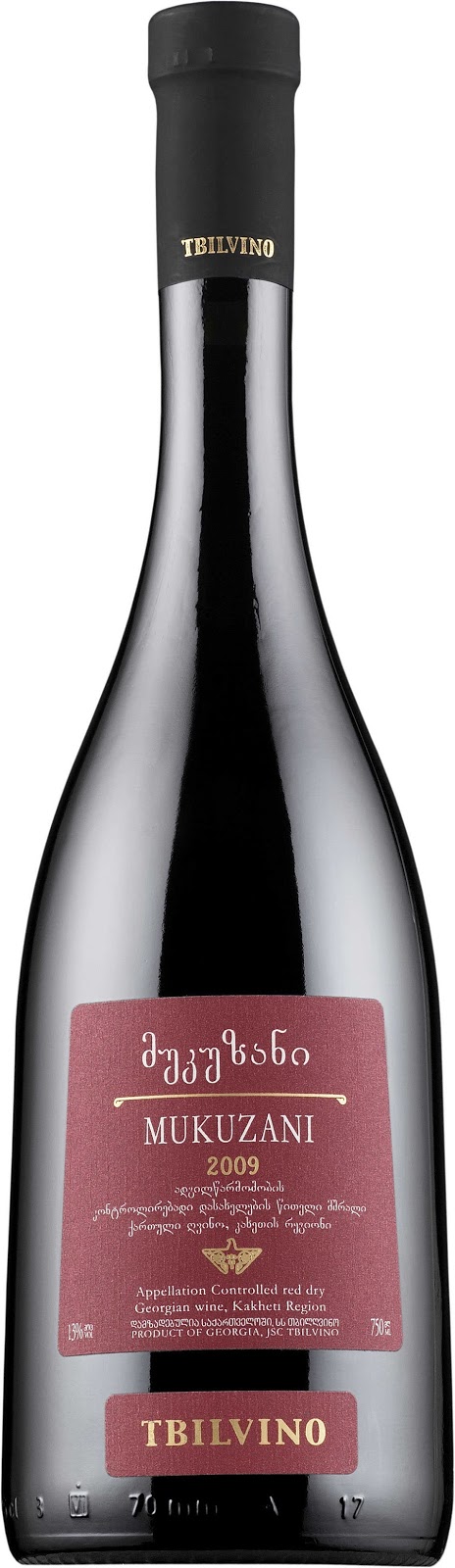
Tbilvino Mukuzani 2012
Mukuzani
  • Tbilvino
  • Country: Georgia
  • Region: Kakheti
  • Grape(s): Saperavi (100%)
  • Price: 14,99€ / 0,75
  • Tasted on: October 24th, 2015


This wine is made by Tbilvino, a winery founded in 1962 that was one of the biggest "wine factories" in the Soviet Union. After the fall of Soviet Union the winery became independently owned and changed their focus from bulk wine to wines of higher quality and character. This wine is a Mukuzani, which means it is a dry Saperavi from the Kakheti region. Unlike regular Saperavi wines, all Mukuzanis must be aged in oak barrels – traditionally the Mukuzani wines were aged extensively in oak, often over 3 years, but currently most commercial Mukuzanis see only 9 months of barrel aging.

The wine has practically completely opaque black-red color, typical of Saperavi.

It has dry, youthful and rather modern-ish nose of prunes, jellied dark berries and ripe black currant. There is also a hint of smoky and spicy oak, but otherwise the nose is very pure and emphasis is on the fruit.

The wine has full-bodied mouthfeel with some sense of concentration, yet feeling fresh and vibrant as well. The ripe palate is dominated by sweet dark fruits, but this sweetness is nicely balanced out by tart lingonberry flavors and a good, tannic bite. There is also a nice undertone of dark cherries and red forest fruits.

The midpalate leaves a lengthy, tight-structured and slightly coarse finish in the mouth with lingering flavors of lingonberry, ink, some bitter and dry woody spice and bright mouthwatering acidity with a hint of tannic astringency in the aftertaste.

87/100
Summary: Superficially this is a modern, polished Saperavi, but underneath its shiny and glossy surface it is a characterful and even a bit rustic red wine with a little welcome roughness in the edges. Though not the most complex effort, but it still shows nice structure and it is wonderfully in balance. I wouldn't surprise if the wine would also benefit from mid-term cellaring. A perfectly enjoyable example of Saperavi.

***

Monastery Wines Saperavi 2012
  • Winery Khareba
  • Country: Georgia
  • Region: Kakheti
  • Grape(s): Saperavi (100%)
  • Price: ?
  • Tasted on: March 2nd, 2016


I was a bit amused by the name of the wine – Monastery Wines Saperavi – because the kvevri wines of Alaverdi Monastery are some of the most acclaimed ones in Georgia. As the Khareba winery started to make kvevri wines some 5 years ago, following the trends, they most likely decided on a name, that would not only invoke mental pictures of the Alaverdi kvevri wines, but also confuse the unknowing customer for the benefit of Khareba.

So this is a wine from the winery's Monastery Wines range, denoting wines made in the clay kvevris. Though the white wines of the range often see extended maceration times of several months in the earthenware vessels, the red wines are usually macerated only as long as the fermentation lasts, usually only for a few weeks.

The wine's color is youthful, slightly translucent dark ruby.

It has an interesting, characterful and very fruit-forward nose of sweet cherry, plummy fruit, some cherry pith, a little boysenberry and a hint of bog bilberry jam.

The moderately full-bodied palate does not manage to reach the interesting, fruity complexity of the nose, but instead offers a rather simple melange of ripe sour cherry, some cranberry, a little sweet dark cherry and a hint of bitterness. The wine lacks structure, as the acidity is modest at best with very unassuming, almost nonexistent tannins.

The wine finishes with a sweeter, juicy aftertaste of ripe dark berries with flavors of blackberry and hints of crowberry on the fore. A little tannic grip brings in some mouth-drying astringency and bitterness to the short-to-medium-length finish.

80/100
Summary: A very soft and smooth example of kvevri Saperavi, lacking the structure and intensity one would expect from such wine. Very mellow and easily approachable; a kvevri wine with training wheels.

***

Orgo Saperavi 2012
  • Teleda / Orgo
  • Country: Georgia
  • Region: Kakheti
  • Grape(s): Saperavi (100%)
  • Price: ?
  • Tasted on: March 2nd, 2016


The Orgo winery is spearheaded by Giorgi "Gogi" Dakishvili, a man better known as the winemaker of more famous Schuchmann and Teliani Valley wineries. The produce many natural-style wines exclusively from their own vineyards and they have specialized in making kvevri wines. All their kvevri wines are made with natural yeasts and the wines are bottled without clarification or filtration with only a minimul sulphur addition.

Luminous dark garnet color with faint purple highlights and a hint of translucency.

Sweet, rich and very unique, meaty nose with most prominent aroma being that of sausage. Yes, that's definitely sausage. Other than that, there are aromas of raw meat, dust, dry old wood, graphite, some leather, a little sweet plums, a hint of cheese and a whiff of smoke. This is definitely some weird stuff – but in a most positive way.

The wine is rich, concentrated and full-bodied in the mouth with super-juicy flavors of ripe plums, sweet dark berries and some cherry – though the nose offered anything but fruits, the palate is completely the opposite. The tannins are quite abundant, yet also very ripe and mellow. Acidity is rather low as well; the wine feels rather big and voluminous, though not fat and wanting for structure.

The moderately long finish is full of supple plummy fruit and dark fruit with some bitterness and a touch of astringency from the tannins.

88/100
A very good, ripe and modern example of a natural kvevri Saperavi that has a very weird – though not that funky – nose but is flavor-wise quite ripe, smooth and easily approachable. An interesting fellow, though nothing mind-blowingly unique.

***

Pheasant's Tears Saperavi 2011
  • Pheasant's Tears
  • Country: Georgia
  • Region: Kakheti
  • Grape(s): Saperavi (100%)
  • Price: 19,85€
  • Tasted on: October 24th, 2015


John Wurdeman's and Gela Patalishvili's winery Pheasant's Tears is one the most-hyped natural wine producers in Georgia. This winery, led by a US-born painter and an 8th-generation grape grower, makes ambitious, structured red and amber wines of remarkable depth with completely hands-off philosophy. All the wines are vinified in kvevris without any kind of intervention, letting the wines ferment and macerate from several weeks to up to 6 months, depending on the variety, and finally bottling the wines without any clarifications, filtrations or sulfur additions.

The wine's color is opaque black red, without any viscous, overextracted look.

The wine has a dense and very rustic nose of dark, dry red fruits, dirt and dust, with notes of fresh blackcurrants and blackberries, meat stew, some smoke, a hint of burnt hair and a whiff of wet dog.

The tongue is greeted by a lovely, energetic palate offering intense flavors of ripe, dark berries, astringent spiciness, wild funk, some sous-bois, a hint of leather and a touch of smoke. The mouthfeel is dense and very full-bodied, yet flavor-wise the wine is surprisingly taut and bone-dry, giving it a paradoxical appearance of a wine that is both big and juicy, yet hard and angular at the same time. With early-picked Saperavi grapes that have been macerated for an extended time, the wine offers lots and lots of acidity with immense, grippy tannic structure.

Finally the wine moves onto its dense, inky aftertaste that leaves a lingering mixture of dark forest fruits, bitter spiciness, leather and a touch of dust. The finish is mouth-drying, astringent and flavor-wise very complex.

92/100
Summary: This Saperavi by Pheasant's Tears is an interesting, fascinating and even challenging red wine that is very unlike any modern "soft", ripe red wine. It is an intense, structured, authentic and unforgiving effort that is definitely not for everyone's taste and it obviously needs either hearty food or lots of cellar age – most likely both; this is not a wine to be enjoyed on its own. Truly wonderful.

***

Askaneli Nata Vachnadze Mukuzani 2007
Mukuzani
  • Askaneli Brothers
  • Country: Georgia
  • Region: Kakheti
  • Grape(s): Saperavi (100%)
  • Price: ?
  • Tasted on: March 2nd, 2016

This wine was a special bottling with a label depicting Nata Vachnadze, a Georgian actress (1904–1953). Despite its special label, I assume the bottle holds the regular Askaneli Mukuzani.

The wine is dark cherry-colored and completely opaque with a hint of haziness and some deposit on the bottom of the glass.

The nose is dusty, developed and quite rich with savory aromas of dark forest berries, dusty earth, leather, plums and notes of blackcurrant and pencil shavings, giving the wine an air of Bordeaux red, with nuances of sweeter oak, some chocolate, a hint of caramel and a touch of bretty farmhouse aromas in the background.

The wine seems more Bordeaux than Saperavi in the mouth with rich, chewy and slightly matured flavors of plums, ripe dark berries, some cedar, a little tobacco and a hint of leather. The structure is intense with moderately high acidity and pronounced, grippy tannins.

The finish is quite grippy and astringent with angular tannins, spicy oak and a lovely, complex mixture of dark berry, pencil shavings, peppery spice, some leather and a hint of rustic bretty notes.

91/100
Summary: While sipping the wine I felt that it might have been more fruit-forward, polished and "modern" in its youth, but now at 8 years of age it was drinking really wonderfully with some attractive, developed and complex characteristics. Even though the wine seemed more like a Bordeaux red than a typical Saperavi, it was really delightful stuff. Apparently a wine that rewards cellaring and will still hold for many years.

***

Winiveria Saperavi 2006
  • Château Mere
  • Country: Georgia
  • Region: Kakheti
  • Grape(s): Saperavi (100%)
  • Price: 25€
  • Tasted on: October 24th, 2015


This wine sealed with a wax capsule is made by Château Mere, a winery-hotel founded in 2005. As the wine was vintage 2006, it was either the second vintage ever of this label. It is a 100% non-interventionist Saperavi vinified in kvevris and bottled without any clarifications or filtrations.

The appearance is completely opaque red-to-black.

It has a very rustic, developed and unforgiving nose of manure, bretty leather, ink, dusty earth, spice and a hint of savory dark berries.

Taste-wise the wine is as rustic and unrelenting as the nose leads to believe: in the mouth it is dense, concentrated and extremely tannic with complex flavors of dark and ripe forest fruits, manure, dried prunes, dust, some leather and a hint of mature raisined fruit. Fresh acidity gives the wine both structure and focus.

The very long, complex, robust and astringent finish leaves notes and nuances of ripe dark berries, dusty earth, tannic bitterness, some leather and a hint of manure in the aftertaste.

95/100
Summary: Winiveria Saperavi 2006 is not only the best Georgian red I've had to this day, but also one of the greatest red wines I've ever had. It is incredibly structured, complex and nuanced effort that definitely calls for both hearty food and extended cellaring. Even at the age of 10 years this is definitely not for the faint of heart, with its combination of very rustic, unpolished character and incredibly tannic structure. These wines I need to seek more and age for a long time – they really do award it.

***

Tamada Kindzmarauli 2012
Kindzmarauli
  • Georgian Wines & Spirits
  • Country: Georgia
  • Region: Kakheti
  • Grape(s): Saperavi
  • Price: 15,49€
  • Tasted on: March 6th, 2015


The Tamada series of wine are a moderately priced range of different Georgian quality wines made by Georgian Wines & Spirits, a beverage company owned by the Dutch company Marussia Beverages. The company produces also another range of wines, Old Tbilisi, which are inexpensive, often sweet and offer really nothing of interest.

Kindzmarauli is an old, unique style of wine from the cooler, northern parts of the famous Kakheti valley, close to the Russian border. It is a semi-sweet red wine style made from Saperavi grapes; the sweetness usually ranges from 30 to 50 g/l with modest alcohol levels of 10–12%. Along with Khvanchkara, Kindzmarauli is considered to be the highest-quality sweet red wine in Georgia. Tamada means a "toastmaster" – a staplemark of Georgian culture: an outspoken person chosen before the dinner among the attendees, having a control over the flow of the dinner, the pouring of the wine and the endless series of speeches and toasts.

The appearance is very dark, almost completely opaque with a hint of higher viscosity from the residual sugar.

The nose is as dark and juicy as the wine looks with sweet, dark-toned aromas of ripe blackcurrants, some freshly picked plums, some blueberry, a hint of smoke and a touch of floral violet nuances.

The palate is obviously medium-sweet and quite full-bodied with moderate acidity and quite ample, ripe tannins that give the palate some sense of structure and firmness. The flavors are rich and expressive with notes of dark, grapey flavors, cherry marmalade, chokeberry, some ripe blackberry and a hint of clove spice.

The wine finishes with a finish that is both moderately sweet and a bit astringent from the tannins, supported by flavors of ripe dark berries, juicy cherries and some fresh blackcurrants in the aftertaste.

Having accustomed to red wines that are either completely dry to barely dry (less than 10 g/l of residual sugar) or really sweet red dessert wines, a medium-sweet red wine like this took me some time to get accustomed to. However, when you realize that this is not really that much of a regular table wine, but instead more like a port wine that drinks like a table wine, you start understanding it a little better.

87/100
Summary: Usually people expect simple, soft and barely drinkable wines when discussing semi-sweet red wines. However, good Kindzmaraulis are anything but. Tamada Kindzmarauli is very balanced, nuanced and nicely structured semi-sweet red that is not really dessert wine, but still works perfectly like one: it is a delightful accompaniment to different cheeses or savory desserts.

August 21, 2016

Aligoté

Aligoté can hardly be considered as a rare variety; with plantings spanning close to 50,000 hectares, this frost-hardy, cool-to-temperate climate grape variety is among the most planted varieties in the world. However, the thing with Aligoté is that it is planted only to a limited extent in France (some 1,900 ha) while the rest of the plantings are found in Eastern Europe, mainly in Moldova (15,800 ha), Ukraine (9,600 ha) and Romania (7,200 ha). As wines from these countries – or Burgundy, for that matter – are rarely exported, Aligoté is a rare occurrence in the international wine market, aimed mainly for local consumption.

The birthplace of Aligoté is somewhere in or near Burgundy, as its parents are Pinot and Gouais Blanc (the parents of Chardonnay, Gamay and Melon de Bourgogne as well, making Aligoté a sibling of these varieties), two grape varieties historically cultivated in the region. Aligoté is known for its remarkably high acid levels and usually thin, lemony flavors; this is why usually fruitier, less acidic and overall more balanced Chardonnay is planted in the best sites in Burgundy, whereas Aligoté is planted in the less prestigious sites in the top and bottom parts of hills. Historically these varieties have been cultivated together as interplanted field blends, where Aligoté's bright acidity would complement Chardonnay's bigger body and fruitier character, but as Chardonnay started to command higher prices, monovarietal Chardonnay vineyards became the norm. A great majority of France's Aligoté is planted in Burgundy (over 1,700 ha) while some plantings can be found also outside Burgundy, mainly scattered around the Rhône wine region.

As Aligoté normally produces simple, tart and lemony wine with thin body and high acidity, it has never gained great popularity, which is why it is mainly drunk locally and rarely exported. A traditional French way to make Aligoté more drinkable is to add a little amount of créme de cassis, blackcurrant liqueur, to the wine to give it more flavor and mask some of the acidity with the liqueur's high sugar, creating a Kir cocktail. The greatest problem Aligoté faces is that it is a prisoner of its reputation; however, some of the producers in Burgundy have showed that by planting the variety in better sites, restricting yields and letting the variety reach a suitable degree of ripeness, it can create wines of remarkable quality – yet still many producers and consumers alike tend to shun away from the variety. Hopefully, as the greatest Aligoté wines start to gain recognition, the variety will receive more acceptance in the future.

One of the biggest recent moves towards the wider recognition of Aligoté is the creation of AOC Bouzeron in 1998. This village in the Côte Chalonnaise wine region (the large subregion under Côte de Nuits, the famed heart of Burgundy) has been producing Aligoté wines for a long time, and finally in the late 1990's, with the aid of Aubert de Villaine – the co-owner of the world-famous Domaine de la Romanée-Conti – this appellation exclusively for Aligoté was created.

Outside Bouzeron, there are also a handful of producers who vehemently believe in the quality and in the potential of well-made Aligoté. These producers in- and outside of Bouzeron can create magnificent Aligoté wines ranging from typical light and acid-driven whites with remarkable depth and steely minerality, to more concentrated and fuller-bodied examples with more fruit, weight and heft normally unseen in wines made from this variety. Typically even the better Aligotés from Burgundy still tend to be lighter than the region's Chardonnays and they are usually aged in stainless steel tanks or old, neutral barrels, letting the varietal characteristics stay on the fore. Though rarely considered to be of any importance in Burgundy, Aligoté's light, refreshingly acid-driven and more restrained style has given Aligoté some attention amongst the sommeliers and other winos who are looking for new, trendy and versatile wine styles.

Claire Naudin "Le Clou 34" 2012
Vin de France
  • Domaine Naudin-Ferrand
  • Country: France
  • Region: Burgundy, Côte de Nuits
  • Grape(s): Aligoté (100%)
  • Price: ~16,50€ / 0,75 l
  • Tasted on: January 3rd, 2015


This wine here does not come from the aforementioned Bouzeron, but instead from the actual heart of world-famed Burgundy wines, Côte des Nuits. The vineyards where the wine is sourced from are located in the AOC Côte des Nuits Villages appellation, but as the wine is very atypical for a white Burgundy, it is declassified as Vin de France.

The wine is produced by Domaine Naudin-Ferrand, a small artisanal producer that can trace its viticultural roots back to the 16th century and the current winery has been located in its current place since 1892. The winery has been spearheaded by Claire Naudin, and under her control, the winery has turned stylistically to a more natural approach. Yields are very restricted, vineyards are cultivated organically and treated as living ecosystems, ideals of sustainable agriculture are followed, and whereas some wines are vinified with the philosopohy minimum intervention and with only very low (20–30 mg/l) sulfite additions, some wines are vinified completely naturally with totally hands-free approach and no sulphites. Claire Naudin has made the choice not to certify the winery organic, as she wants to have a freedom of choice: she thinks that in bad scenarios is better to use minuscule amounts of very effective synthetic weed, pest and fungus control agents instead of less effective organic ones.

Naudin-Ferrand has become famed especially for their unique Aligotés; whereas many other growers have pulled off their Aligoté plantings to make room for economically more viable Chardonnay, Naudin-Ferrand have obstinately held on to their Aligoté plantings, which are now among some of the oldest ones in the whole Burgundy. Clou 34, the plot that is the main source for this wine, is planted in 1934, but in some vintages grapes are also sourced from plots La Croix (planted in 1953), Castaings (1936) and Vallerot (1902). This wine is made completely organically: both the alcoholic fermentation and the malolactic fermentation occurred naturally, the wine has received no additions whatsoever, it was bottled unfiltered and unfined and no sulfites were used at any point. Annual production is less than 3,000 bottles.

With its hazy, green-tinted yellow color, the wine is obviously unfiltered.

The nose is utterly delightful, vibrant and expressive with crisp and intense, fruit-forward aromas of sweet lemony citrus fruit, sunny flower meadows, red apple, some leesy notes and a hint of grapefruit.

The intense taste follows the nose with intense green apple and grapefruit-dominant citrus fruit flavors, supported by saline minerality and some leesy notes. Overall the palate is juicy, concentrated and really energetic with its pronounced, crisp acidity.

The finish is really crisp, tart and acid-driven with flavors of wet stone minerality, lime-driven citrus fruit, tart Granny Smith apple and some grassy greenness. The aftertaste is very long, precise and focused with pronounced acidity.

Overall Le Clou 34 is an incredibly impressive example of a complex, pure and focused Aligoté with remarkable concentration and well-balanced structure. As it is a good example of completely hands-off winemaking, it might not be the first pick for people who enjoy their wines crystal-clear and squaky-clean; however those, who are looking for unique, high-quality examples of honest, pure wines, this is an extremely recommended effort. It is hands down one of the loveliest white Burgundies I've had in a while, and probably the best non-Chardonnay Burgundy white I've ever had. At 16,50€ its QPR is incredible.

93/100
For those who doubt Aligoté's potential for making high-quality wines, Le Clou 34 can be a revelation. It is a wine of remarkable depth, complexity and concentration, but not without the typical acidity and brightness of the variety.

August 16, 2016

Trollinger

Trollinger is hands down the most ubiquitous speciality of Germany's southern region of Württemberg. This usually large-berried, thin-skinned variety is used to make vast amounts of simple, easy-drinking red that is extremely popular within the region, but rather rarely seen outside it.

This variety is better known as Schiava outside Germany – mainly in northern Italy, which is both the variety's home region and a place where it is most often encountered. There are, however, at least four different and genetically distinct Schiava varieties: Schiava Gentile, Schiava Grigio, Schiava Grosso and Schiava Lombarda. Out of these four varieties, the smaller-berried Schiava Gentile is considered to be of the highest quality, producing wines of more depth, concentration and structure. The larger-berried Schiava Grossa is, instead, the variety that is most widely planted, thanks to its vigor, high yields and ease of cultivation. This is also the variety that has made its way to Germany, where it is known as Trollinger – most likely a corruption of the word Tyrolinger, referring to Tyrol, the home of the variety.

The more up north you are in Germany, the more you are in the beer drinking part of the country; conversely, the closer you are to the south border, the higher the wine consumption goes, at the expense of beer. Württemberg is – along with Baden – the most southernmost wine region of Germany, and also the region where most wine is consumed per capita. Whereas most other German wine regions have made name with their wines throughout the world, Württemberg has preferred to drink up its own wines. Traditionally the local wines were cheap and of no real character, made exclusively for local consumption, not export; one of the most popular wine styles was Trollinger mit Lemberger a simple, semi-sweet red wine made mostly from simple Trollinger with some Lemberger (aka. Blaufränkisch) blended in to bring the wine some notion of structure. Only recently have local producers started to make attempts at making more serious, dry varietal wines out of Trollinger, but there is still a lot of work to be done: partly because people still associate Württemberg with cheap, uninteresting, low-quality wines; partly because it is nigh impossible to make anything of real interest of this variety.

Last May I had the privilege to visit many different wine producers in Württemberg, and what I learned was that Trollinger is not a variety made to shine bright: the large size of the berries results in high juice-to-skin ratio, and with its thin skins low in coloring polyphenols and tannins, the wines usually have a rather soft structure. The resulting wines are usually easy-drinking, fruity, medium-acid red wines that occasionally look more deep rosés than actual reds, with soft, easy tannins and both aromas and flavors of sweet red berries. The wines are normally fermented and aged both in stainless steel tanks and in oak casks, but usually older, bigger stück barrels are used because the variety does not go well with oak aromatics. Usually Trollinger's skins can be macerated quite extensively with the wine with no noticeable increase in color, tannins or extraction, which is why usually the skin maceration times are quite low.

Here is a selection of different Trollingers we tried during our trip:

Staatsweingut Weinsberg Trollinger Trocken 2014
  • Staatsweingut Weinsberg
  • Country: Germany
  • Region: Württemberg
  • Grape(s): Trollinger (100%)
  • Price: 5,90€ / 0,75 l
  • Tasted on: May 19th, 2016


The wine is made by Staatsweingut Weinsberg, the state-controlled winery and school for wine makers. This institute not only makes wines from its own vineyards and tutors future winemakers, but also makes groundbreaking work as experimenting with different varieties, creating new crossings. I have no details on the vinification of this wine, but it has 3 g/l of residual sugar and 4,9 g/l of acidity.

The translucent, pale raspberry color of the wine with its almost completely clear rims seems almost closer to a rather deep rosé wine than an actual red wine, typical of the variety.

The nose is fruity with aromas of raspberry marmalade, wine gum candies and some cherry jam.

In the mouth the wine has a light body with flavors of ripe red berries like raspberries, wild strawberries and some cherries with a hint of sour cherries. Smooth, medium-intense acidity with soft and easy mouthfeel.

The midpalate transitions into the fresh and somewhat lengthy finish with flavors of red berries, some sour cherries and a hint of tart lingonberries.

All in all, this is an easy-drinking, basic-level everyday red and nothing more. Light, soft, smooth and easily approachable – like practically every single Trollinger in the world.

78/100
Summary: Nothing of real interest, but priced accordingly. A textbook example of Württemberg Trollinger that is churned in ridiculous amounts every year in the region.

***

Weingut Singer Trollinger Steinreinacher Hörnle 2014
  • Weingut Singer
  • Country: Germany
  • Region: Württemberg
  • Grape(s): Trollinger (100%)
  • Price: 6,80€ / 0,75 l
  • Tasted on: May 20th, 2016


A bit atypical Württemberg Trollinger in the sense that this is a single vineyard Trollinger aged in old barrels. It is made by a small family winery located in the village of Korb; they cultivate 15 ha of vineyards and their annual production is in the range of only 50,000 bottles. The Singers have a Weinkorb ("wine basket"), a combined winery and local centre of wine culture, in Korb, that is worth seeking out if you happen to be in the vicinity. 4,7 g/l of acidity and 13% of alcohol.

Clear and translucent dark cherry color.

The nose is quite reductive with smoky aromas of ripe dark cherry, gunpowder, flint and pepper. Nothing that moderate aeration or more bottle age couldn't fix.

In the mouth the wine is light-to-mid-bodied with moderate acidity and soft mouthfeel. Flavors of smoke, pepper, flint and some cranberry-lingonberry giving the wine almost Pinot Noir-like feel. Underneath, a light undercurrent cocoa oak aromatics and a touch of floral nuances. The wine shows a nice combination of intensity and Trollinger's gentle approachability.

The finish is quite long and lively with flavors of wild strawberry, bitter spice, peppercorns, some smoke and a hint of dried wood.

This wine is a bit oakier than the Trollingers of the region generally are, but still very modest with its oak aromatics. In a nutshell this is a balanced effort and definitely one of the better Trollingers I've had – it is actually surprisingly serious an effort for the variety. I am positively surprised by its intensity, and additionally the wine is very modestly priced at 6,90€.

86/100
Summary: A bit more serious Trollinger sourced from a single vineyard, offering good intensity and faint old oak aromatics.

***

Weingut Heid Trollinger PUR Trocken 2015
  • Weingut Markus Heid
  • Country: Germany
  • Region: Württemberg
  • Grape(s): Trollinger (100%)
  • Price: 6,00€ / 0,75 l
  • Tasted on: May 20th, 2016


A wine produced by a small producer that has converted their production to organics. In pursuit of quality and recognition, the yields are kept in check, the wines are fermented with their own natural yeasts and old oak is preferred over new whenever oak is used. The producer is also recognized by the high quality of their sparkling Winzersekt wines and they are a member of VDP, the German quality wine association. The Heids have a wonderful winery / tasting room / wine shop right in the middle of the city of Fellbach; it is worth seeking out just because of the quality of the wines Markus Heid produces. PUR is Heid's simple, straightforward example of Trollinger, made to be drunk within a year or two; stylistically somewhere between a rosé and a red wine. Residual sugar 4 g/l, acidity 5 g/l, alcohol 11,9%.

Bottled in a clear bottle just to show the variety's typical, clear, luminous raspberry color.

The wine has a spicy nose with aromas of tart red berries, like cranberries and raspberries, supported by notes of red cherries and a touch of positive, herbal greenness.

In the mouth the wine is light, pure, lively and refreshing with lovely, bright acidity. Vibrant flavors of raspberry, wild strawberry, some gravelly minerality and a touch of sour cherry.

The finish is long and clean finish flavors of sour cherry, raspberry and tart red berries.

PUR is a really lovely, clean, refreshing and even surprisingly structured Trollinger – it lacks the soft and gentle characteristics of a traditional Württemberg Trollinger and has replaced them with nice crispness and intensity. On the surface the wine drinks like a care-free summer wine, but in reality it is a lot more serious and impressive effort than what other producers usually make out of Trollinger. Very lovely both on its own and with food. At 6€ this is a real find.

88/100
Summary: Exceedingly tasty and balanced Trollinger that lacks the variety's typical softness. Vibrant and refreshing wine that drinks like a simple table wine, but with impressive intensity and seriousness. Thoroughly recommended.

***

Weingut Heid Trollinger Erste Lage Fellbach Lämmler 2014
  • Weingut Markus Heid
  • Country: Germany
  • Region: Württemberg
  • Grape(s): Trollinger (100%)
  • Price: 9,50€ / 0,75 l
  • Tasted on: May 20th, 2016


A wine produced by the same producer as Trollinger PUR, Markus Heid. An attempt to make something more serious of Trollinger: an Erste Lage (equal to Premier Cru) -level single vineyard Trollinger that is fermented on its own natural yeasts and aged for 6–8 months in 600 liter oak casks. Residual sugar 1g/l, acidity 5,1 g/l, alcohol 12,6%.

Clear, dark cherry color that is something not unlike a Burgundy Pinot Noir – a bit darker what you'd normally expect from a Trollinger.

A little restrained, yet charming nose of raspberry, dark cherry, wild strawberry, some kirsch and a touch of blueberry.

Light, lively and acid-driven in the mouth with such intensity and body I've yet to taste in any other Trollinger; there's even some sense of concentration here. Juicy palate with vibrant flavors of dark berries, strawberry, raspberry, some sour cherry, a little dark cherry and a touch of tart cranberry. The structure is held together not only by the lively acidity, but with a light touch of tannins as well.

Dry, long, acid-driven and slightly tannic finish with focused flavors of ripe, raspberry-driven red berries and dark forest fruits.

Wow! This is really impressive and classy an effort for a Trollinger and definitely the best I've had from this usually rather bland variety. Stylistically not so far from a lighter Cru Beaujolais with similar mouthfeel, vibrancy and balance. Very serious, tasty and moreish; lovely on its own, easy to pair with a wide variety of foods. The wine has simply an incredible QPR at 9,50€.

90/100
Summary: Most likely one of the best Trollingers there is, if not the best. Remarkable intensity, purity and structure for a Trollinger with even some welcome sense of concentration. Very recommended for the fans of Gamay, Poulsard and the likes.

***

Weinmanufaktur Untertürkheim Trollinger Trocken *** 2013
  • Weinmanufaktur Untertürkheim
  • Country: Germany
  • Region: Württemberg
  • Grape(s): Trollinger (100%)
  • Price: 14,00€ / 0,75 l
  • Tasted on: May 20th, 2016


A wine made by the small, quality-oriented co-operative in the village of Untertürkheim, a hamlet of Stuttgart. This is their attempt at making something more serious out of Trollinger, designated by the stars in the label (* and ** stand for simple, basic-level wines). This is made from the grapes of approximately 25 years old vines. Extended maceration of 3 weeks with the skins, after which the wine is aged for 12 months in big, old oak casks. Residual sugar 2 g/l, acidity 4,6 g/l, alcohol 13,5%.

Clear, dark raspberry red color.

Dry, pretty aromatic, savory and slightly meaty nose with aromas of ripe red berries, sour cherries and some darker berries – definitely something more interesting than your average Trollinger with just sweet red berry aromas.

In the mouth the wine is medium-bodied and rather soft, but it has also some nice roughness due to somewhat pronounced spiciness and slight bitterness. Flavors of sour cherry, cranberry and hints of ripe strawberries. Low on tannins.

The palate segues into the spicy, medium length finish with flavors of dark forest fruits, allspice and some sour cherry.

This is a well-made, high-quality Trollinger that seems to be above the average Trollinger quality and a testament to the quality of the Untertürkheim co-op. However, this wine does not give challenge to those wonderful Trollingers made by Weingut Heid. Otherwise it is a surprisingly lovely, balanced and enjoyable effort showing that it is possible to make serious red wines out of this often overlooked variety. If you are iffy about the quality of South German Trollingers, this is definitely a wine that is worth a shot. Priced accordingly at 14€.

87/100
Summary: A serious and balanced Trollinger that manages to go beyond the regular Trollinger scope of soft, round mouthfeel and simple flavors of ripe red berries.

August 10, 2016

Žlahtina

Croatian wines aren't particularly mainstream, although they have garnered moderate attention and even some international fame in the past years. However, the lion's share of the attention paid to the Croatian wines go mainly to the bright, acid-driven and mineral Malvazija Istarska whites from the Istrian peninsula located at the westernmost part of Croatia, and to the concentrated, opulent and tannic Plavac Mali reds from the Pelješac peninsula, located at the southeastern part of Croatia, close to Dubrovnik.

These two grape varieties may basically be all that the great majority of people know about Croatian wine, but there is a whole lot more to Croatia than these two varieties. After all, as a wine country, Croatia has one of the biggest arsenal of indigenous varietals in the world, totaling a whopping 130 different local varieties. Almost all of them are varieties that have never traveled outside the country and, unfortunately, too many varieties are made in so minute quantities that producing wine in commercial quantities may be close to impossible and thus no-one will ever hear from them.

However, there has been a growing interest in local minor varieties in the recent years, after all kinds of different wines made from obscure grape varieties started to become more popular around the world. One of the more interesting varieties that has gained popularity in the past few years is Žlahtina – a variety that takes its name after the word žlahtno, "noble". Though this variety is allowed in the Istrian peninsula and Hrvatsko Primorje (Coastal Croatia), it is a specialty of the Krk island, as it is nowadays found nowhere outside the isle.

Krk, located between the Istrian peninsula and the Coastal Croatia, is the most populous island of the Adriatic Sea and, along with the neighboring island of Cres, the biggest one as well. Historically grapegrowing was of a lot bigger importance with over 25,000 hectares under vine (some 6% of the island's area), whereas nowadays only some 250 hectares of vineyards survive – that is only 1% of the vineyards from the vinous heyday of the island. Of these 250 hectares, Žlahtina represents some 95% of the plantings, the remaining 5% mainly planted with local, obscure varieties. Almost all of the plantings are situated close to the town of Vrbnik, located to the eastern shore of the island. However, most of the plantings are located somewhat inland, safe from the Bura wind blowing throughout the region.

Contrary to what one might expect from a variety called "noble", Žlahtina is a vigorous, high-yielding variety, from which the local producers traditionally made fruity but thin and undistinguished white wines. Though popular in the past, the variety fell from favor after the modern winemaking arrived in Croatia. Only recently has Žlahtina garnered popularity after some trailblazing local vignerons started to experiment with the variety, trying to make something more serious and ambitious out of it. One of the best characteristics of the variety is its slow and late ripening time, which suits the warm Mediterranean climate very well – even in hot summers, the variety struggles to reach high sugar levels and even when very ripe, it will keep its acidity, resulting in rich and fruity wines with low alcohol and good acid structure. The variety is often labeled as Zlatna Žlahtina ("golden Žlahtina") or Vrbnička Žlahtina ("Žlahtina from Vrbnik").

Katunar Estate Žlahtina 2013
  • Katunar Estate
  • Country: Croatia
  • Region: Hrvatsko Primorje (Coastal Croatia), Krk
  • Grape(s): Žlahtina
  • Price: 36 Kn (4,75€) / a glass of 15 cl
  • Tasted: July 21st, 2015


A 100% Žlahtina made by a local family winery. Originally the Katunar family sold their crop to the local wine co-op, as it was the only option under the communist regime. As it was possible to produce wine as a privately owned producer from the early 1990's, Katunar then quit the local co-op and started producing their own wine. They were the first winery in Krk to modernize the local winemaking by introducing temperature controlled tanks and introducing other modern winemaking techniques to the local, traditional methods of making wine.

I imagine this wine is fermented and aged in steel tanks, seeing that the winery has also a Žlahtina Barrique, but I can't say for certain. 11,5% of alcohol.

The wine has lemon color with greenish highlights.

In the glass it has a rich, sweet and tropical nose with aromas of banana, pear, pineapple and honeydew melon. The aromas create expectations of a wine that is very fruit-forward, full-bodied and even heavy.

Rich flavors follow the nose, but with a lot less sweet character. Instead of being heavy and ponderous, the palate is medium bodied and quite acid-driven, yet surprisingly soft and smooth with a good sense of ripeness. Notes of fresh, lemony citrus fruits, green apple, pineapple, wet stone minerality, some cantaloupe and a touch of banana roll around the tongue.

The wine's long, refreshing and acid-driven finish leaves flavors of green apples, citrus fruits in the mouth, supported by good stony minerality and some sweeter honeydew melon notes.

The wine shows an interesting marriage of very ripe and rich notes yet surprisingly modest body and good structure, giving it remarkable drinkability. By its aromas and flavors, it is definitely a warm/hot region white, but without any of that typical excessive ripeness and ponderous character. This is an enjoyable and balanced wine that drinks nicely on its own, but can be easily paired with numerous lighter, Mediterranean dishes.

89/100
Summary: A very nice and refreshing Žlahtina with a typical, heady aroma and lovely, refreshing and mineral-driven palate. An enjoyable example of this very rare Croatian variety from the isle of Krk.

***

PZ Vrbnik Zlatna Vrbnička Žlahtina 2014
  • Poljoprivredna Zadruga Vrbnik
  • Country: Croatia
  • Region: Hrvatsko Primorje (Coastal Croatia), Krk
  • Grape(s): Žlahtina
  • Price: 40 kn (5,27€) / a glass of 15 cl
  • Tasted: July 19th, 2015


A wine by the local co-operative, Poljoprivredna Zadruga Vrbnik – or just PZ Vrbnik in short. The wine is made from the grapes grown by local small producers, fermented with selected yeasts and aged in steel tanks. The alcohol levels are normally 11% to 11,5%, residual sugar under 1 g/l and acidity around 5 g/l.

The wine has pale green color, making it appear a bit more youthful than the Katunar version.

The wine has rich and heady, even exuberant nose typical of Žlahtina. Attractive, fruity notes of cantaloupe, honeydew melon, ripe pear, orange blossom and freshly pressed apple juice – just lovely!

In the mouth the wine is intense and a bit more fuller-bodied compared to the Katunar Žlahtina – yet sporting similar kind of fresh, lively and surprisingly acid-driven structure. The flavors follow the nose, but in drier and more savory form, expressing flavors of ripe apple, pear peel, some cantaloupe, a little rocky minerality and a touch of grass.

After the midpalate comes the long and crisp finish with a lingering aftertaste of apple, grass, cantaloupe and some spicy bitterness.

All in all, this co-op's Žlahtina is a very lovely, ripe and interesting Krk white with very high drinkability – even more so than the Katunar one! Just like a good Žlahtina should, it combines lovely freshness and bright acid structure to ripe, juicy fruit character, resulting in an interesting, characterful white of superb balance. Unique, high-quality stuff, very recommended.

91/100
Summary: A terrific, balanced white that epitomizes the white wine style of the Coastal Croatia – ripe, rich and succulent tropical fruit characteristics married to wonderful bright acidity and lovely freshness.